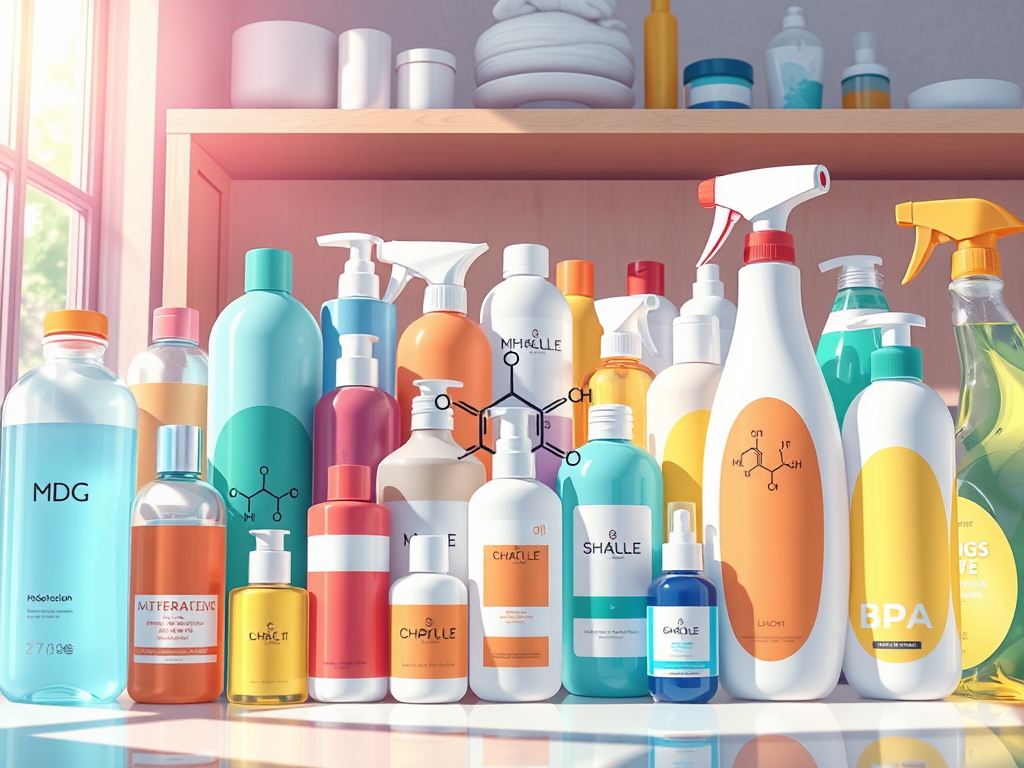
What are endocrine disruptors?
Endocrine‑disrupting chemicals (EDCs) are substances that can mimic, block, or interfere with natural hormones (like estrogen, testosterone, thyroid hormones, and cortisol). They may act at very low doses, and effects can depend on timing (pregnancy, puberty, menopause) and cumulative exposure (Lisco et al., 2022; Kirtana & Seetharaman, 2022).
Common EDC families relevant to personal care & cleaning:
- Phthalates (often hidden in “fragrance”) (Symeonides et al., 2024)
- Parabens (preservatives) (Petric et al., 2021)
- Phenols (e.g., bisphenol A/BPA, BPS, triclosan, benzophenone‑3/oxybenzone) (Reale et al., 2021; Marques et al., 2022; Mustieles et al., 2023; Matouskova & Vandenberg, 2022)
- PFAS (“forever chemicals,” in water‑resistant cosmetics, nonstick, and stain‑repellent products) (Mokra, 2021; Coperchini et al., 2021)
- UV filters in sunscreens (e.g., oxybenzone/BP‑3, octylmethoxycinnamate/OMC) (Matouskova & Vandenberg, 2022; Lorigo et al., 2024)
- Pesticides/biocides (e.g., atrazine, glyphosate) (Zhao et al., 2024; Muñoz et al., 2021)
- Heavy metals (e.g., cadmium) (Bimonte et al., 2021)
- Micro‑ and nanoplastics and additives (Ullah et al., 2023)
Where do EDCs come from in daily life?
- Personal care & cosmetics: fragrance/perfume, hair products (straighteners, relaxers), lotions, deodorants, nail products, sunscreens, makeup (Schildroth et al., 2024; Mustieles et al., 2023; Matouskova & Vandenberg, 2022; Lorigo et al., 2024)
- Cleaning products & air fresheners: both conventional and some “green” products can release VOCs; ventilation matters (Calderon et al., 2022)
- Plastics & packaging: food containers, plastic wraps, thermal paper receipts (skin absorption of BPA/BPS) (Reale et al., 2021; Symeonides et al., 2024)
- Water, stain‑resistant materials & nonstick: possible PFAS (Mokra, 2021; Coperchini et al., 2021)
- Pesticides/herbicides: home/garden use, lawn care (Zhao et al., 2024; Muñoz et al., 2021)
- Occupational exposures: e.g., firefighters; salon and cleaning work (Poutasse et al., 2022)
Biomonitoring shows EDCs can be detected in humans, including menstrual blood (Ason et al., 2022) and follicular fluid (Hallberg et al., 2023).
How EDCs affect health (mechanisms & outcomes)
Mechanisms of action (MOA):
- Hormone receptor binding/antagonism (estrogen, androgen, thyroid receptors), altering gene expression (Lisco et al., 2022; Marques et al., 2022; Matouskova & Vandenberg, 2022)
- Thyroid axis disruption (synthesis, transport, metabolism of T3/T4) (Pearce, 2024; Coperchini et al., 2021; Zhang et al., 2022)
- Mitochondrial dysfunction & oxidative stress, linked to insulin resistance and diabetes risk (He et al., 2024)
- Immune & inflammatory pathways, including links with autoimmunity (Huang et al., 2023) and infectious response modulation (Araiza et al., 2021)
- Epigenetic changes (DNA methylation, histone modification) that may have intergenerational effects (Kirtana & Seetharaman, 2022; Dias et al., 2025)
- Placental & fetal impacts (barrier function, transporters, inflammation) (Yan et al., 2023; Fouyet et al., 2022)
Selected health outcomes (evidence snapshots):
- Women’s health & fertility: EDCs are linked with ovulatory dysfunction, ovarian reserve changes, implantation issues, and miscarriage risk; hair product exposures matter in reproductive‑aged Black women (Tricotteaux‑Zarqaoui et al., 2024; Hassan et al., 2024; Hallberg et al., 2023; Schildroth et al., 2024; Puche‑Juarez et al., 2023)
- Men’s reproductive health: reduced semen quality, endocrine changes, and erectile function impacts from estrogenic EDCs (Feijó et al., 2021; Cripps et al., 2024; Calivarathan & Mathur, 2025)
- Pregnancy & children: EDCs can affect placental development and are associated with adverse pregnancy outcomes; early‑life exposure may influence offspring brain development/behavior and childhood asthma (Yan et al., 2023; Puche‑Juarez et al., 2023; Dias et al., 2025; Kuraoka et al., 2024)
- Thyroid: PFAS, phthalates (e.g., DEHP), triclosan, and other EDCs can disrupt thyroid function (Pearce, 2024; Coperchini et al., 2021; Zhang et al., 2022; Marques et al., 2022)
- Breast cancer: epidemiologic studies link certain EDC exposures with breast cancer risk (Wan et al., 2022)
- Metabolic disease & diabetes: mitochondrial toxicity and plasticizer exposures are linked to insulin resistance and type 2 diabetes (He et al., 2024; Tuculina et al., 2022; Bimonte et al., 2021)
- Skin & hormones: EDCs interacting with hormone receptors may contribute to acne pathophysiology (Rao et al., 2021)
- Autoimmune disease: associations between EDC exposures and autoimmune disorders have been reported (Huang et al., 2023)
- Not everything is an EDC: Vitamin D3 (cholecalciferol) should not be classified as an endocrine disruptor (Souberbielle et al., 2022)
Key point: Effects can occur at low doses and may be stronger during sensitive windows (pregnancy, puberty, midlife changes) (Lisco et al., 2022; Kirtana & Seetharaman, 2022).
Practical solutions: How to check current products and buy cleaner ones
Use free tools:
- Environmental Working Group (EWG):
- Skin Deep® database for cosmetics/personal care
- Healthy Living™ app (scan barcodes on your phone)
- EWG VERIFIED® mark signals products that meet stricter ingredient standards
Read labels & avoid common red flags:
- “Fragrance/parfum” (can hide phthalates) → choose fragrance‑free when possible (Symeonides et al., 2024)
- Parabens (methyl‑, propyl‑, butyl‑, isobutyl‑paraben) → consider paraben‑free options; note ongoing debate about risk magnitude (Petric et al., 2021)
- Triclosan (antibacterial) → avoid where possible (Marques et al., 2022)
- Oxybenzone (benzophenone‑3)/OMC → prefer mineral sunscreens (zinc oxide, titanium dioxide) (Mustieles et al., 2023; Lorigo et al., 2024; Matouskova & Vandenberg, 2022)
- PFAS (look for “fluoro‑,” “PTFE,” or “perfluoro‑”) → choose PFAS‑free products (Mokra, 2021; Coperchini et al., 2021)
Cleaning smarter:
- Choose fragrance‑free detergents/cleaners; avoid aerosolized air fresheners
- Even “green” cleaners can emit VOCs—ventilate (open windows, use exhaust fans); consider simpler formulations (soap, water, microfiber) (Calderon et al., 2022)
- Wet‑mop and dust regularly to remove settled chemicals and microplastics (Ullah et al., 2023)
Reduce plastic contact with food & skin:
- Do not microwave food in plastic; use glass/ceramic
- Prefer stainless steel or glass bottles/containers
- Limit handling thermal receipts; store e‑receipts when possible (Reale et al., 2021)
Water & cookware:
- Consider water filters that reduce PFAS where feasible; avoid damaged nonstick cookware; choose cast iron, stainless steel, or ceramic (Mokra, 2021; Coperchini et al., 2021)
Special situations:
- Pregnancy & preconception: prioritize fragrance‑free, mineral sunscreen, and simpler routines; reduce pesticide use; ventilate during cleaning (Puche‑Juarez et al., 2023; Yan et al., 2023)
- Occupational exposures: firefighters, salon, custodial work—use PPE, improve ventilation, and wash hands before eating (Poutasse et al., 2022)
Expect gradual, meaningful progress:
- Start with the products you use most and on the largest skin areas (body lotion, shampoo/conditioner, detergent)
- Replace items as you run out; small changes add up
Quick Swap Guide
- Sunscreen: Choose zinc oxide/titanium dioxide (non‑nano if preferred) → avoid oxybenzone/BP‑3, OMC (Mustieles et al., 2023; Lorigo et al., 2024)
- Moisturizer/Body lotion: Fragrance‑free, paraben‑free; short ingredient lists
- Deodorant: Fragrance‑free options; avoid antibacterial triclosan
- Hair care: Minimize products with strong fragrance; be mindful of relaxers/straighteners exposure patterns (Schildroth et al., 2024)
- Makeup: Look for EWG VERIFIED® or low‑hazard ratings; avoid PFAS‑containing mascaras/liners (“fluoro‑/PTFE”)
- Cleaning: Use fragrance‑free detergent; simple all‑purpose cleaner; ventilate when using any cleaner (Calderon et al., 2022)
- Food & drink: Use glass/steel containers; avoid microwaving plastic; wash produce to reduce pesticide residues (Muñoz et al., 2021)
Key messages to share in clinic
- EDCs are common but modifiable. Lowering exposure is realistic with small, steady changes (Lisco et al., 2022)
- Sensitive windows matter: preconception, pregnancy, childhood, puberty, and midlife (Pearce, 2024; Puche‑Juarez et al., 2023)
- Outcomes are multi‑system: reproductive, thyroid, metabolic, immune, cancer, and neurodevelopmental (Pearce, 2024; He et al., 2024; Huang et al., 2023; Wan et al., 2022; Dias et al., 2025)
- Use EWG tools (free app/website) to scan or look up products during visits; consider prioritizing by highest‑use items first.
References
Ason, B., Armah, F. A., & Essumang, D. K. (2022). Characterization and quantification of endocrine disruptors in female menstrual blood samples. Toxicology Reports, 9, 1877–1882. https://doi.org/10.1016/j.toxrep.2022.10.007
enAraiza, V. H. D. R., Mendoza, M. S., Castro, K. E. N., Cruz, S. M., Rueda, K. C., de Leon, C. T. G., & Morales Montor, J. (2021). Bisphenol A, an endocrine-disruptor compound, that modulates the immune response to infections. Frontiers in Bioscience (Landmark edition), 26(2), 346–362. https://doi.org/10.2741/4897
Bimonte, V. M., Besharat, Z. M., Antonioni, A., Cella, V., Lenzi, A., Ferretti, E., & Migliaccio, S. (2021). The endocrine disruptor cadmium: a new player in the pathophysiology of metabolic diseases. Journal of Endocrinological Investigation, 44(7), 1363–1377. https://doi.org/10.1007/s40618-021-01502-x
Calderon, L., Maddalena, R., Russell, M., Chen, S., Nolan, J. E. S., Bradman, A., & Harley, K. G. (2022). Air concentrations of volatile organic compounds associated with conventional and “green” cleaning products in real-world and laboratory settings. Indoor Air, 32(11), e13162. https://doi.org/10.1111/ina.13162
Calivarathan, L., & Mathur, P. P. (2025). Effect of endocrine disruptors on testicular function. In Advances in Experimental Medicine and Biology (Vol. 1469, pp. 115–125). https://doi.org/10.1007/978-3-031-82990-1_6
Coperchini, F., Croce, L., Ricci, G., Magri, F., Rotondi, M., Imbriani, M., & Chiovato, L. (2021). Thyroid Disrupting Effects of Old and New Generation PFAS. Frontiers in Endocrinology, 11, 612320. https://doi.org/10.3389/fendo.2020.612320
Cripps, S. M., Marshall, S. A., Mattiske, D. M., Ingham, R. Y., & Pask, A. J. (2024). Estrogenic endocrine disruptor exposure directly impacts erectile function. Communications Biology, 7(1), 403. https://doi.org/10.1038/s42003-024-06048-1
Dias, G. R. M., Giusti, F. C. V., de Novais, C. O., de Oliveira, M. A. L., Paiva, A. G., Kalil-Cutti, B., Mahoney, M. M., & Graceli, J. B. (2025). Intergenerational and transgenerational effects of endocrine-disrupting chemicals in the offspring brain development and behavior. Frontiers in Endocrinology, 16, 1571689. https://doi.org/10.3389/fendo.2025.1571689
Feijó, M., Martins, R. V. L., Socorro, S., Pereira, L., & Correia, S. (2021). Effects of the endocrine disruptor vinclozolin in male reproduction: A systematic review and meta-analysis. Biology of Reproduction, 104(5), 962–975. https://doi.org/10.1093/biolre/ioab018
Fouyet, S., Olivier, E., Leproux, P., Dutot, M., & Rat, P. (2022). Pregnant Women and Endocrine Disruptors: Role of P2X7 Receptor and Mitochondrial Alterations in Placental Cell Disorders. Cells, 11(3), 495. https://doi.org/10.3390/cells11030495
Hallberg, I., Björvang, R. D., Hadziosmanovic, N., Koekkoekk, J., Pikki, A., van Duursen, M., Lenters, V., Sjunnesson, Y., Holte, J., Berglund, L., Persson, S., Olovsson, M., & Damdimopoulou, P. (2023). Associations between lifestyle factors and levels of per- and polyfluoroalkyl substances (PFASs), phthalates and parabens in follicular fluid in women undergoing fertility treatment. Journal of Exposure Science & Environmental Epidemiology, 33(5), 699–709. https://doi.org/10.1038/s41370-023-00579-1
Hassan, S., Thacharodi, A., Priya, A., Meenatchi, R., Hegde, T. A., R, T., Nguyen, H. T., & Pugazhendhi, A. (2024). Endocrine disruptors: Unravelling the link between chemical exposure and Women’s reproductive health. Environmental Research, 241, 117385. https://doi.org/10.1016/j.envres.2023.117385
He, K., Chen, R., Xu, S., Ding, Y., Wu, Z., Bao, M., He, B., & Li, S. (2024). Environmental endocrine disruptor-induced mitochondrial dysfunction: a potential mechanism underlying diabetes and its complications. Frontiers in Endocrinology, 15, 1422752. https://doi.org/10.3389/fendo.2024.1422752
Huang, R. G., Li, X. B., Wang, Y. Y., Wu, H., Li, K. D., Jin, X., Du, Y. J., Wang, H., Qian, F. Y., & Li, B. Z. (2023). Endocrine-disrupting chemicals and autoimmune diseases. Environmental Research, 231(Pt 2), 116222. https://doi.org/10.1016/j.envres.2023.116222
Kirtana, A., & Seetharaman, B. (2022). Comprehending the Role of Endocrine Disruptors in Inducing Epigenetic Toxicity. Endocrine, Metabolic & Immune Disorders Drug Targets, 22(11), 1059–1072. https://doi.org/10.2174/1871530322666220411082656
Kuraoka, S., Oda, M., Ohba, T., Mitsubuchi, H., Nakamura, K., Katoh, T., & Japan Environment and Children’s Study (JECS) Group. (2024). Association of phenol exposure during pregnancy and asthma development in children: The Japan Environment and Children’s study. Environmental Pollution, 361, 124801. https://doi.org/10.1016/j.envpol.2024.124801
Lisco, G., Giagulli, V. A., Iovino, M., Guastamacchia, E., Pergola, G., & Triggiani, V. (2022). Endocrine-Disrupting Chemicals: Introduction to the Theme. Endocrine, Metabolic & Immune Disorders Drug Targets, 22(7), 677–685. https://doi.org/10.2174/1871530321666210413124425
Lorigo, M., Quintaneiro, C., Breitenfeld, L., & Cairrao, E. (2024). Exposure to UV-B filter octylmethoxycinnamate and human health effects: Focus on endocrine disruptor actions. Chemosphere, 358, 142218. https://doi.org/10.1016/j.chemosphere.2024.142218
Marques, A. C., Mariana, M., & Cairrao, E. (2022). Triclosan and Its Consequences on the Reproductive, Cardiovascular and Thyroid Levels. International Journal of Molecular Sciences, 23(19), 11427. https://doi.org/10.3390/ijms231911427
Matouskova, K., & Vandenberg, L. N. (2022). Towards a paradigm shift in environmental health decision-making: a case study of oxybenzone. Environmental Health, 21(1), 6. https://doi.org/10.1186/s12940-021-00806-y
Mokra, K. (2021). Endocrine Disruptor Potential of Short- and Long-Chain Perfluoroalkyl Substances (PFASs) – A Synthesis of Current Knowledge with Proposal of Molecular Mechanism. International Journal of Molecular Sciences, 22(4), 2148. https://doi.org/10.3390/ijms22042148
Muñoz, J. P., Bleak, T. C., & Calaf, G. M. (2021). Glyphosate and the key characteristics of an endocrine disruptor: A review. Chemosphere, 270, 128619. https://doi.org/10.1016/j.chemosphere.2020.128619
Mustieles, V., Balogh, R. K., Axelstad, M., Montazeri, P., Márquez, S., Vrijheid, M., Draskau, M. K., Taxvig, C., Peinado, F. M., Berman, T., Frederiksen, H., Fernández, M. F., Marie Vinggaard, A., & Andersson, A. M. (2023). Benzophenone-3: Comprehensive review of the toxicological and human evidence with meta-analysis of human biomonitoring studies. Environment International, 173, 107739. https://doi.org/10.1016/j.envint.2023.107739
Pearce, E. N. (2024). Endocrine Disruptors and Thyroid Health. Endocrine Practice, 30(2), 172–176. https://doi.org/10.1016/j.eprac.2023.11.002
Petric, Z., Ružić, J., & Žuntar, I. (2021). The controversies of parabens – an overview nowadays. Acta Pharmaceutica, 71(1), 17–32. https://doi.org/10.2478/acph-2021-0001
Poutasse, C. M., Haddock, C. K., Poston, W. S. C., Jahnke, S. A., Tidwell, L. G., Bonner, E. M., Hoffman, P. D., & Anderson
 Restorative Source